Split Payments: How to Determine If Your Marketplace or Platform Needs to Route Funds to Multiple Recipients
Split payments are one of the most consequential architectural decisions for any marketplace or platform business, yet many companies only confront the question after their payment volume has already outgrown the wrong setup. Determining whether your business model requires split payments — and how funds should be routed to multiple recipients — affects compliance scope, technical integration effort, cash flow control, and long-term scalability.
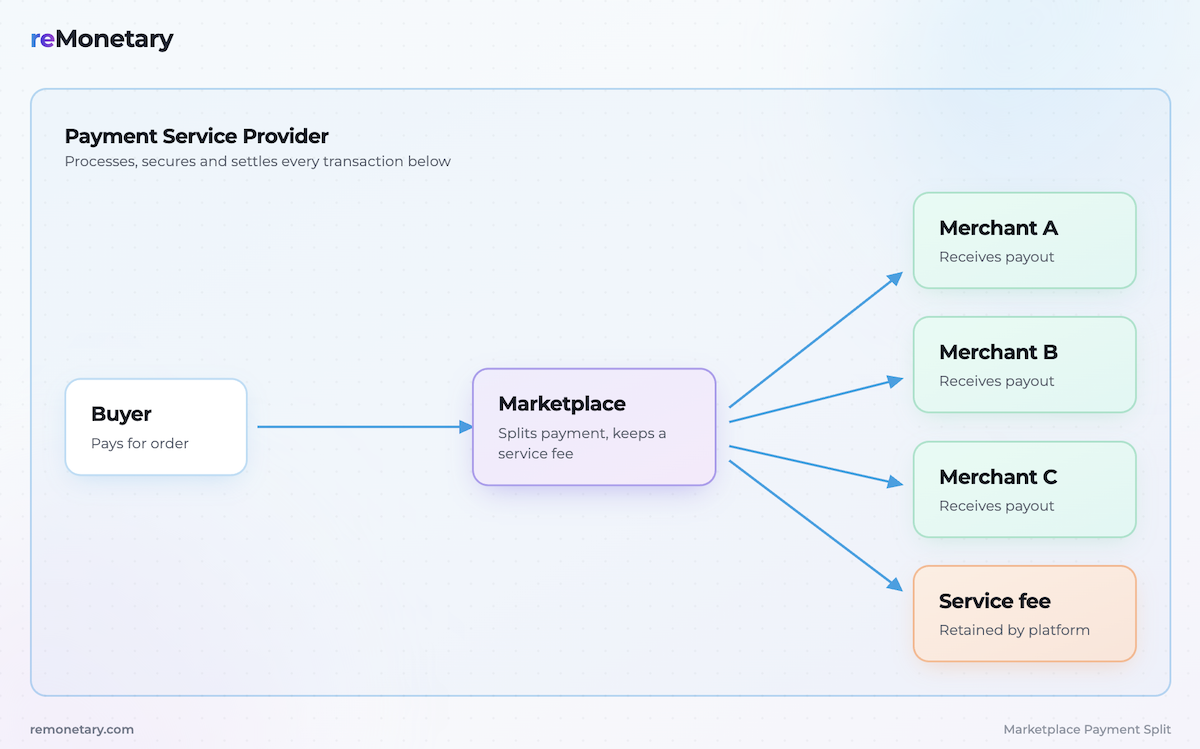
In this guide, we break down how to know if you need split payments, the two main implementation models (PSP-managed vs. self-managed), and the regulatory implications of each approach.
What Are Split Payments in Marketplace and Platform Business Models?
Split payments refer to automatically dividing a single transaction between multiple recipients, rather than collecting the full amount into one account and manually redistributing it afterward. This is a core requirement for any business acting as an intermediary between a buyer and one or more third-party sellers or service providers.
How to Determine Whether Your Business Needs Split Payments
This need typically arises in marketplace, platform, and multi-party business models. If your business facilitates transactions between a buyer and one or more third parties — sellers, service providers, freelancers, or partners — and you take a commission or fee on top, you likely need split payments. Common examples include marketplaces connecting buyers and sellers, platforms distributing payouts to gig workers or creators, and booking platforms that route funds to independent service providers while retaining a margin.
By contrast, if your business sells its own products or services directly and simply pays suppliers or partners through normal accounts payable processes, you likely do not need automated split payments — a standard merchant payment setup is sufficient.
The key test: does the money legally and financially belong to a third party at the moment of transaction, rather than to your business first? If yes, routing those funds through your own account before redistributing them introduces both regulatory exposure and operational complexity that automated split payment solutions are specifically designed to avoid.
Option 1: PSP-Managed Split Payments
In a PSP-managed model, the payment service provider handles the splitting logic natively, dividing incoming transactions between the platform and its sellers or recipients according to rules defined via API. Providers such as Mangopay and Adyen for Platforms offer built-in split payment functionality designed specifically for marketplace use cases.
These providers typically allow the platform to define split rules per transaction — specifying the recipient, the amount or percentage owed to each party, and the platform's own commission — often within the same API call used to initiate the payment. Funds are routed directly to sub-accounts or connected accounts belonging to each recipient, rather than passing through the platform's own bank account first.
Why Platforms Choose PSP-Managed Splitting
This model significantly reduces regulatory exposure, since a regulated payment institution — not the platform — routes the funds. It also removes the operational burden of manually calculating and executing payouts, and it scales cleanly as transaction volume and the number of recipients grow.
The Trade-Off
Reduced flexibility around timing and control. Payout schedules, hold periods, and reserve management are typically governed by the PSP's own risk and compliance policies, which may not always align with the platform's preferred cash flow or seller experience.
Option 2: Self-Managed Splitting via Direct Payouts
An alternative approach is for the platform to receive the full transaction amount into its own bank account and then manually or programmatically calculate and execute payouts to recipients afterward, using standard bank transfers or a separate payout provider.
This model offers maximum control over timing, reconciliation logic, and the payout experience, since the platform isn't constrained by a PSP's built-in splitting rules. It can, in principle, be combined with any PSP, since it doesn't rely on the payment provider offering native split functionality.
Why This Approach Is Riskier
Because funds pass through the platform's own account before reaching recipients, the platform may be considered to be holding client money, even briefly — which can trigger e-money or payment institution licensing requirements in many jurisdictions. The platform also becomes responsible for reconciliation, payout accuracy, and handling failed or delayed transfers.
Self-managed splitting is generally only advisable for platforms with very low transaction volumes, highly specific payout logic that no PSP can accommodate, or an existing regulatory license that already permits holding client funds.
Regulatory Implications of Split Payments
Regulatory exposure is the central factor distinguishing PSP-managed from self-managed split payment models. In most jurisdictions, including under EU and UK payment services regulation, any entity that receives and briefly holds funds belonging to a third party before forwarding them risks being classified as providing a regulated payment service, regardless of intent.
PSP-Managed Splitting
This model largely shields the platform from regulatory classification as a payment service provider, since the regulated PSP — not the platform — is technically routing and briefly handling the funds. This is often referred to as an agency or "pass-through" model, and most licensed PSPs explicitly structure their split payment products to preserve this status for their platform customers.
Self-Managed Splitting
This model removes that protection. Platforms taking this route should assess, ideally with legal counsel, whether their activity requires a payment institution license, an e-money license, or an exemption under local regulation. This assessment should happen before volume scales, since retrofitting a licensing structure onto an existing payment flow is significantly more disruptive than designing for compliance from the outset.
Choosing the Right Split Payment Architecture
Selecting between PSP-managed and self-managed split payments requires weighing regulatory exposure, operational overhead, and control against one another — with regulatory exposure typically carrying the most weight for early-stage platforms.
For most marketplaces and platforms, PSP-managed splitting is the more sustainable choice, since it minimizes licensing risk while providing purpose-built tooling for commission handling, payout scheduling, and multi-party reconciliation. Self-managed splitting should generally be reserved for edge cases where PSP capabilities genuinely fall short of business requirements, or where the platform already operates under an appropriate license.
Regardless of the model chosen, split payment architecture should be evaluated early and revisited as the business grows, since the right structure at low volume isn't always the right structure at scale. Treating split payments as a compliance-driven architectural decision — rather than a purely technical integration detail — allows platforms to build payout infrastructure that remains stable and defensible as transaction complexity increases.
Platforms must also decide how sellers interact with the payment infrastructure, including whether merchants receive direct access to the PSP dashboard, selected PSP reporting capabilities, or only access to payment information through the platform. This is a separate architectural decision that affects merchant experience, operational ownership, and technical integration requirements.